


Anyone serious about model railways knows that stability, flexibility, and expandability are essential. That is exactly where the Dinamo system excels.
And just as importantly: The Dinamo control system essentially consists of only 3 different components to control your analog and digital trains as well as all accessories: the RM-C, TM44, and OC32. This keeps the system very clear. Partly because of this, Dinamo easily grows along with your model building hobby: you simply add more of the same components.
The name DINAMO stands for Digital Interface Network for Analog MOdel railways. The term “Analog” here stems from distant history, because in addition to the original analog concept, Dinamo now also supports the DCC protocol.
This hybrid control makes Dinamo unique: you can run old analog locomotives alongside the latest digital models without any problems, right on the same track, mixed together. No expensive or complicated conversions needed – just put your rolling stock on the rails and drive.
Analog and digital at the same time on the same track, surely that’s impossible? Actually, it isn’t. Let’s take you into the world of Dinamo and explain the principle.
In real-world railways, train movement is (fortunately) protected so that trains cannot collide. To achieve this, the track is divided into blocks. A block is a section of track where a maximum of one train may be present. Signals are placed between the blocks. A train may only enter the next block if that next block is empty.
In the following image, you can see a simplified version of what we mean: The train in block 1 may enter block 2 because block 2 is empty and the signal is green. The train in block 3 may not enter block 4 because that block is occupied. The signal is red.

At Dinamo, we make clever use of this principle. Just like in real-world railways, we divide the track into blocks. And with Dinamo, we also give each block its own electrical control. Since safety rules dictate that only one train can be in each block and each block is controlled separately, we can control every train exactly how we want.
Now, controlling a model railway using block control isn’t that unusual. But the unique thing about Dinamo is that this control changes dynamically: the system adapts like a chameleon. If an analog train is in a block at any given time, Dinamo controls that block analogically. If a digital train is in that block at another time, Dinamo controls that block digitally. And an analog train can still accelerate and decelerate smoothly, just like a digital train. You can even keep the lights of your “analog” coaches on while the train is stationary. Dinamo makes the differences in driving behavior between analog and digital very small.
To be honest, Dinamo cannot handle this dynamic adjustment entirely on its own. Dinamo makes it possible—it provides the toolbox—but it needs software to actually do it. Keeping track of which train is where, where it wants to go, and determining which blocks need which type of control is quite a task. Therefore, in practice, Dinamo is always combined with a computer and control software. There are quite a few software packages available today to control your model railway, but not all of them understand how to manage a layout using block control. That’s why we recommend using software packages that excel at this and have been tested with Dinamo.
You might think: Okay, so everything works fully automatically with Dinamo! It can, but it doesn’t have to. All the software we recommend offers the operator various ways to still do things “manually,” via hand controllers or commands given through the computer. The computer and software are there to take the complicated work off your hands, while still letting you decide what you want to do yourself.
The most commonly used software to control Dinamo is iTrain, however, programs like Koploper and RocRail also support this system. And which program is “the best”? Well, that depends very much on you as a hobbyist. Our dealers and partners can advise you on this.
If you are going to use a computer and software to control your model railway, that software needs to know what is happening. It doesn’t really matter whether you run a block-controlled system like Dinamo or a digital train-controlled system. To let the software know what is happening, we usually use occupancy detectors and feedback modules. An occupancy detector is electronics that can measure if there is a power consumer on a section of track. Of course, it makes no sense if your occupancy detector is connected to your entire layout. You must electrically isolate the “section of track” that you want the computer to monitor from the rest. Then, you need to ensure that the information from your occupancy detector is passed to your computer. This communication is handled by your “feedback system.”
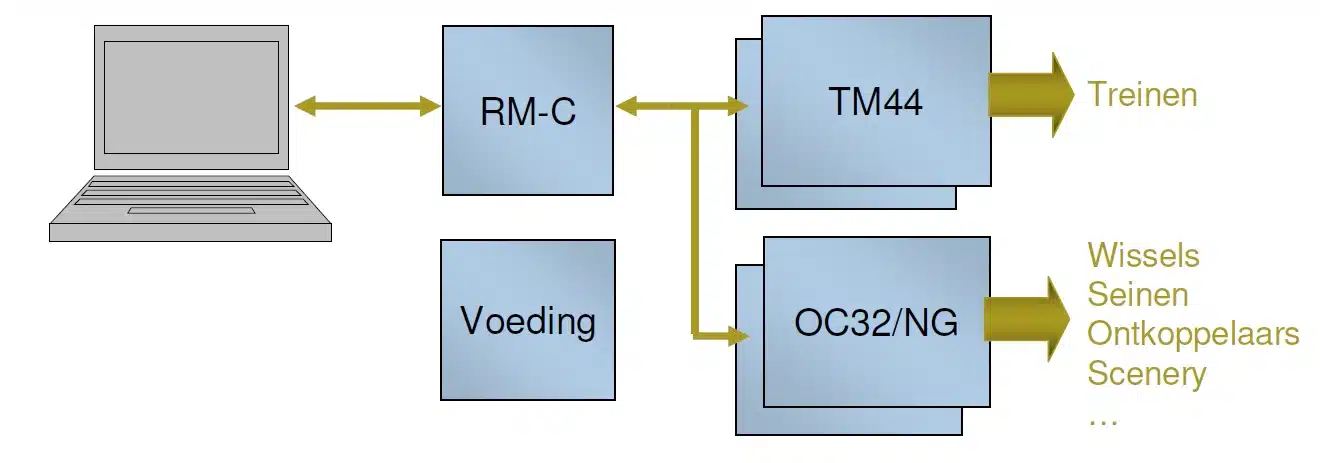
The entire setup of Dinamo can be captured in the simple diagram you see here. It essentially consists of only 3 different modules: an RM-C, TM44s, and OC32s. The number of the latter two depends solely on the size of your miniature world. We explain these modules in more detail below.
You build the Dinamo network from the RM-C, where all modules are connected via an RS485 bus. The RS485 bus can be implemented using standard network cables (patch cables) or, for enthusiasts, via custom-laid twisted wiring.
And if you start small and have no idea where you’ll end up: the system literally grows with you!
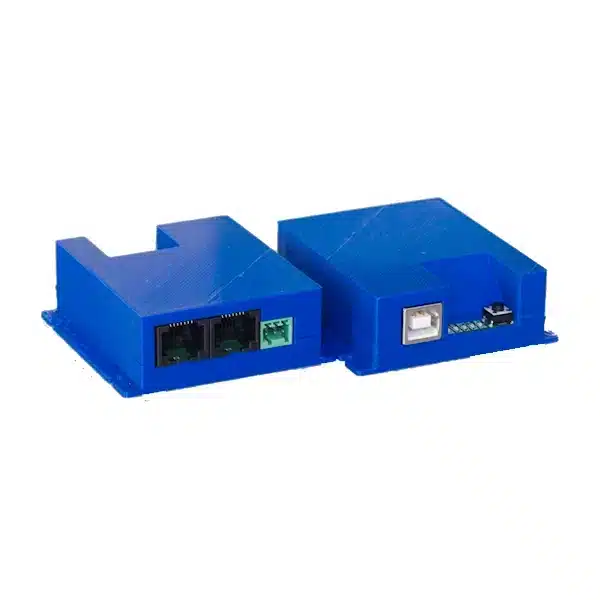
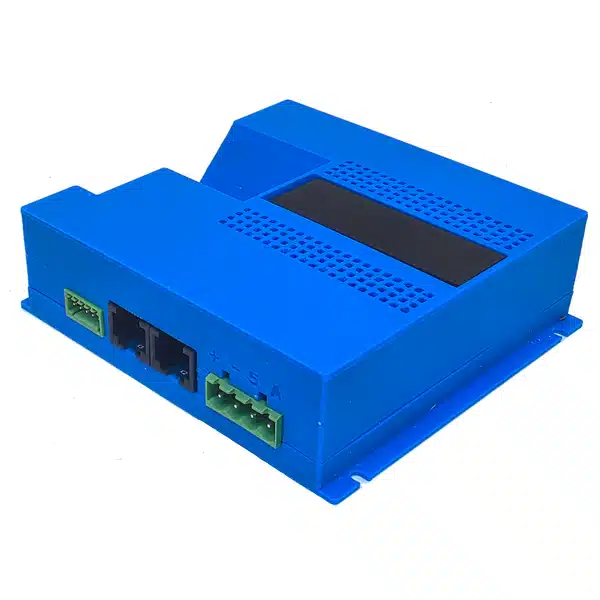
The RM-C forms the link between your computer and all (other) Dinamo modules. It is easily connected to your PC via USB and controls the rest of your system via the robust RS485 bus.
Communication via USB: easy connection to your PC.
Reliable RS485 connection: interference-free, even over hundreds of meters.
Galvanic isolation (2.5 kV): optimal protection for PC and layout.
Compact and ready to use: supplied in a sturdy housing, plug & play.
The RM-C supports all modern Dinamo modules: the TM44 for train control, the OC32 for your turnouts and signals, and UCCI for controlling your moving model cars. But you can also still connect modules from the Dinamo Classic range.
The RM-C is available in 2 versions so you can choose the one that best fits your ambitions: from a compact layout to a complete miniature world!
Where the RM-C is the brain, the TM44 is the muscle.
Controls 4 blocks independently.
Accurate pulse width modulation for analog trains.
Integrated and constant high-frequency lighting for analog trains:
The lights in your coaches stay on, even when stationary.
DCC control for digital trains.
Short-circuit protection per block.
4 occupancy detectors with feedback per block.
The TM44 is supplied both with and without housing. With housing for maximum physical protection, or if you want it to look good under and behind your miniature world. Without housing for slightly lower costs, but without housing, the modules are also stackable to save space.
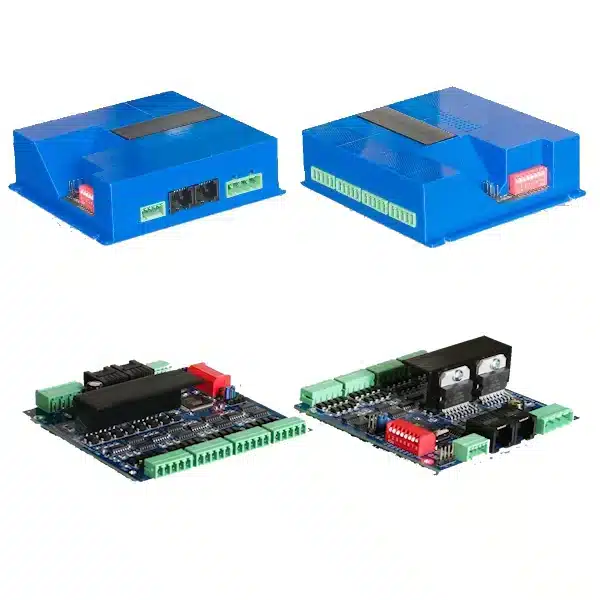
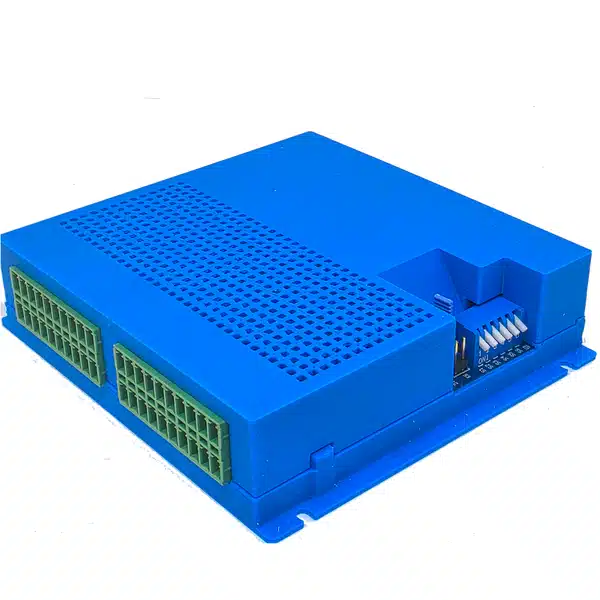
The OC32 is a product that you can also use separately. For a clear overview of all possibilities, please refer to the relevant section on our website.
But within the Dinamo ecosystem, we simply use the OC32 to control everything except the trains themselves, and possibly the cars, if you combine them into one system. Like the TM44s, OC32s are connected to the RM-C on the same RS485 communication bus.
Turnouts: dual-coil drives, motors, servos
Semaphore signals: Controlled with coils, motors, servos, memory wire.
Color light signals: All signaling systems from all countries.
And if it doesn’t exist yet, you can add it yourself. But we’d rather help you with that, so we can add another system to our standard definitions.
Uncouplers
Level crossings
Depot doors
Just like the TM44, the OC32 is available with or without housing.
Well, undeniably the least sexy part of your control system, but necessary.
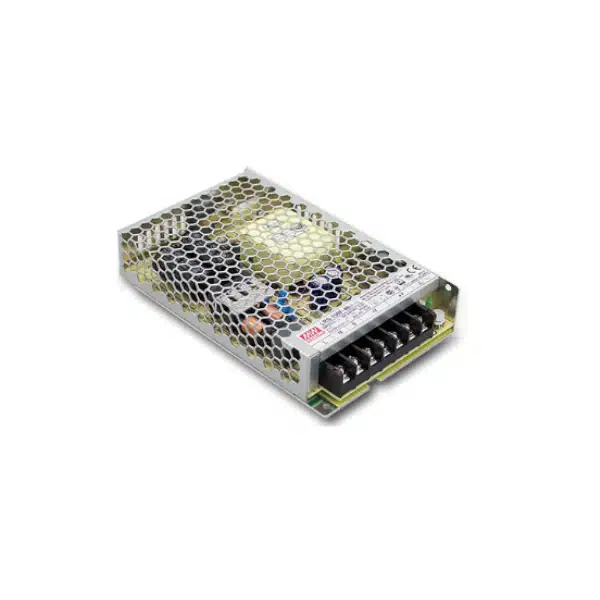
Your trains, all accessories, and the electronics that control them all need energy, and the power supply provides it with the right voltage and required power. Nowadays, there are many good, standard power supplies for sale for relatively little money. A good power supply doesn’t have to cost more than a few tenners. You can save money by scavenging the power supply from an old PC or using an old model train transformer. Our advice: don’t do it. The savings on the total cost of your layout are negligible, and you almost never have the exact power supply you need.
It is important that (for Dinamo) the power supply delivers a stable DC voltage and, above all, that it is sufficiently safe, preferably proven by a (in Europe: European) quality mark.
Also note that specific requirements may apply in various countries, both for the device itself and for the way it is connected and even who is allowed to connect it. If you are sufficiently informed and electro-technically skilled, feel free to make your own choice using common sense. Otherwise, our dealers and partners can advise you perfectly, taking your wishes, ambitions, and local regulations into account.
It’s great that Dinamo controls each block independently. But all that electronics makes it very expensive!
Well, it’s actually not that bad. The Dinamo electronics are cleverly designed and make extensive use of microcontrollers. This keeps the electronics themselves relatively simple. And, for example, a TM44 provides many functions in one “box”: it is a digital command station, power supply, occupancy detector, and feedback module all in one. The experience of “layout builders” who work with both digital systems and Dinamo shows that the total price for the control system does not differ structurally. And that’s not even counting the costs for decoders in your trains!
With Dinamo, I have to connect each block separately. That takes an awful lot of wiring.
Manufacturers of many digital systems promise that you only need to connect 2 wires and you can drive. If you control that system by hand, that is indeed true. Until your layout grows and you start adding a computer and software. Then you suddenly find yourself in the world of occupancy detectors, feedback modules, boosters, reverse loop modules, turnout decoders, signal decoders, etc. And you have to connect all of those too. In the end, it makes almost no difference in practice.
Dinamo is just very complicated.
Managing all those blocks correctly and making them work together perfectly is indeed quite complicated. But fortunately, you don’t have to do it. It has all been thought out and worked out for you in electronics and software. The only thing you need to do is understand the principle of Dinamo. And if the explanation above isn’t gibberish to you, you’re already halfway there. Then you just have to apply it consistently. Actually, it’s quite simple, because the structure of Dinamo consists of only two different modules that you connect to each other via network cables as one continuous daisy-chain system.
If I’m going to equip all my locos with a decoder eventually anyway, I might as well get a “normal” digital system.
Of course, that is a choice everyone has to make for themselves. But Dinamo has more advantages than just being able to run analog. Because each block has its own power supply and control and not “everything is connected together,” it makes finding and solving faults much easier. If a fault occurs somewhere, the rest of your layout just keeps running. Reverse loop problems are not solved with Dinamo; they simply don’t exist because they are prevented by the system design. And because each block has its own digital command station, the control also grows with the size of your miniature world. Dinamo is demonstrably reliable, even for very large layouts.
Dinamo is a great system, however, some basic knowledge of electrical engineering, or the willingness to learn it, is useful. Unlike “conventional digital systems,” the learning curve with Dinamo is not higher in the end, but it is steeper. Just connecting two wires and grabbing a hand controller isn’t an option. That being said, it is ultimately exactly the same work as when you automate a layout with any other system. The difference is that with Dinamo, you have a control system without limitations and the tricky challenges that a conventional system often faces.
Our dealers and partners offer you a tailored consultation and can help you at the start of your adventure. With support, training, and workshops, we help you with the application of the entire system. As a customer, you can also use the Dinamousers forum on this website, where you can submit your questions and problems, or exchange ideas with the Dinamo community.
With Dinamo, you lay a solid foundation for a layout that offers complete freedom, not just today but also tomorrow.
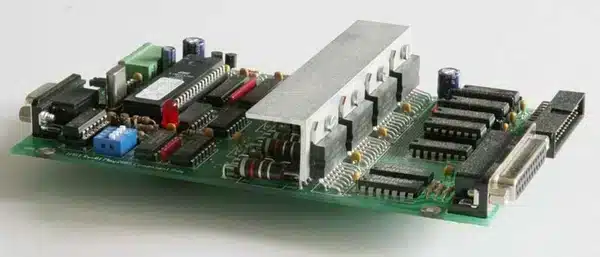
Dinamo once started as a DIY project. A system consisting of bare circuit boards that users had to populate with electronic components themselves. Since 2006, the former PiCommIT managed to bring these modules to market as ready-to-use products. Because of this (and the use of Dinamo at Railz Miniworld, now Miniworld Rotterdam), the popularity of the system grew enormously, leading to the transition to the current system in mid-2012. The old classic modules are still available for enthusiasts and can be combined with the current system with some modifications.
Incidentally, the Dinamo Classic system is the only one that can be adapted to provide enough power for large scales, such as LGB. If you need this version, MCC ModelCarParts specializes in this.
Module with housing
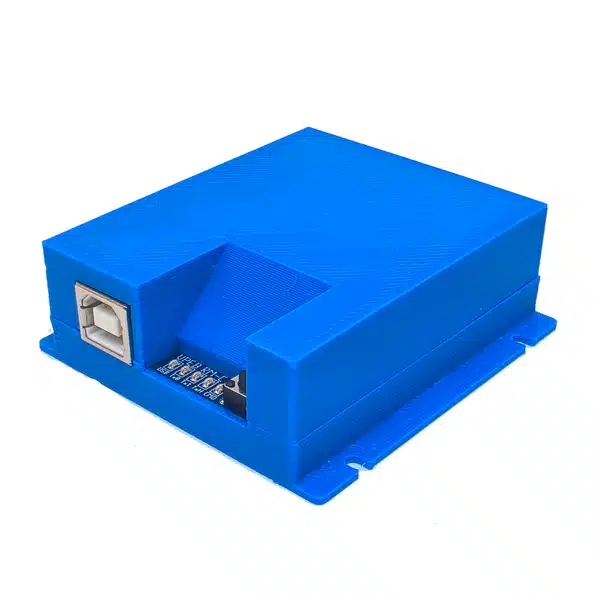
The basic central unit for Dinamo
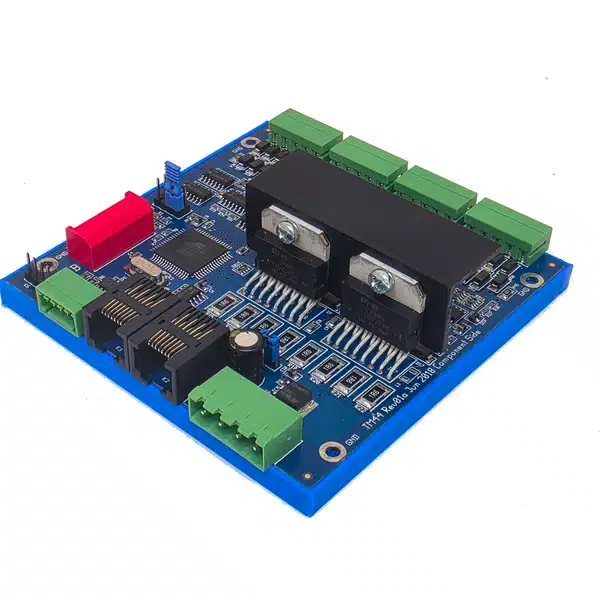
Module without housing, with mounting frame
The dual-bus central unit for Dinamo
For relay-controlled blocks
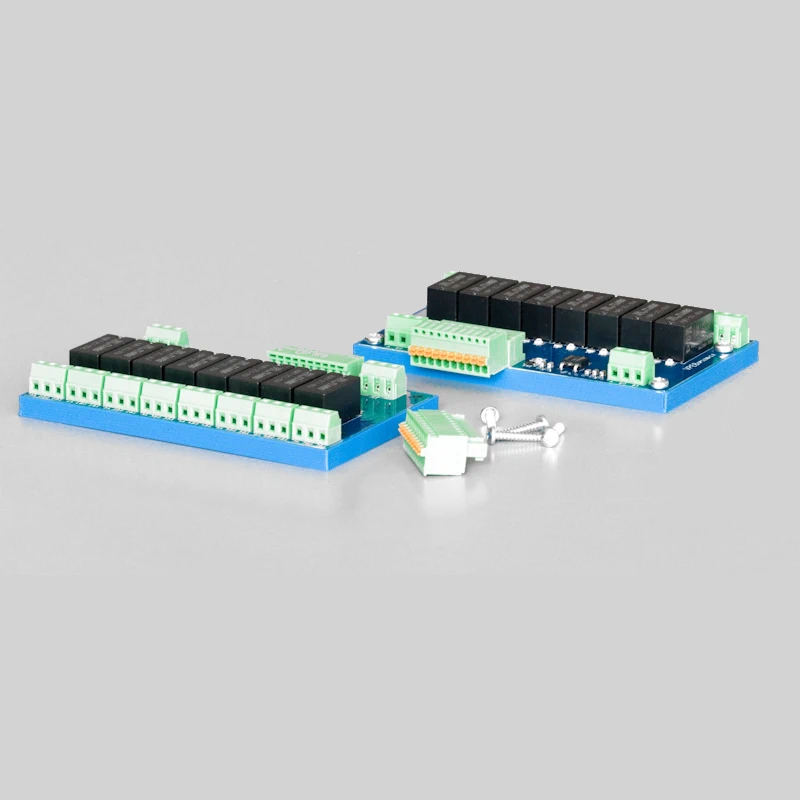
For relay-controlled blocks