Hybride Modelbaan Besturing

Voor analoog en digitaal


Hybride modelbaan besturing

Voor analoog en digitaal

Discover the versatility of the OC32 accessory controller

one module, endless possibilities.

OC32

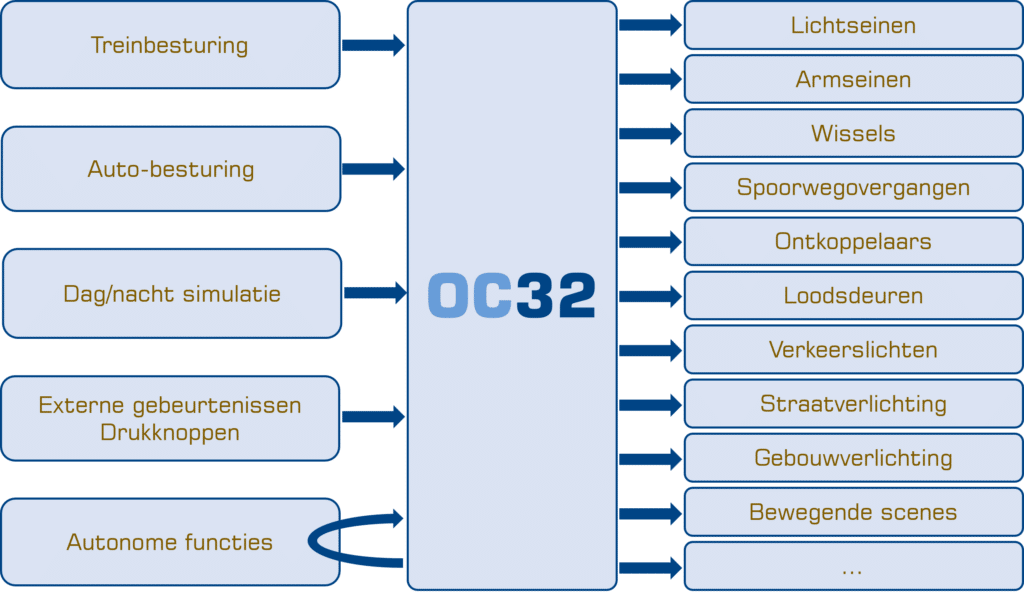
The OC32 controls everything in your miniature world, except your trains and cars.

The OC32 from VPEB is much more than a classic switching decoder. Where a standard decoder is often limited to switching a few turnouts or lights, the OC32 offers no less than 32 extensively configurable outputs that you can use for signals, traffic lights, turnouts, lighting, servos, motors, relays, etc. In short, basically everything you encounter in your miniature world.

The OC32 can be controlled as a DCC accessory decoder from any digital station that supports DCC. But at the same time, you can also control the OC32 directly from a PC with suitable software, integrate it into a Dinamo or Dinamo/MCC system, combine it with systems for an extremely realistic day/night simulation, or simply let it function completely independently. And the OC32 can be controlled interactively with discrete inputs, such as switches and push buttons. The OC32 is therefore not only very powerful in what you can control with it, but also very flexible in the way you want to control it all.

What can you do with the OC32?

Many electronic control modules are intended for one specific task. And you often buy such a module for that task, such as controlling a few turnouts, making the lights of your level crossing flash, or controlling a few signals. And then, depending on the signaling system, you sometimes also need a specific version of such a decoder. Need a new function? New decoder!

The OC32 offers a completely different approach to controlling accessories in your miniature world. You don’t have to wonder what you want to control, nor what you want to control it with. At most, you might wonder how much you want to control. You easily configure the OC32 for the specific tasks you expect from the module, even if those tasks change or when new tasks are added.

For the novice user, there is an extensive collection of standard configurations. In OC32 terms, we call these “device definitions”. You simply choose which “device” (signal, turnout, traffic light, etc.) you want to connect to which outputs of the OC32. The experienced user has the option to fully customize the OC32 through extensive configuration.

OC32 functies nl

Applications of the OC32 accessory decoder

Bring your model railway to life with the OC32:

Controllable by all common systems

Suitable for all types of accessories

Fully configurable

Future-proof

The OC32 is equipped with a bootloader, allowing you to easily load software updates yourself. New features and improvements are therefore always available.

OC32NG AD Complete back
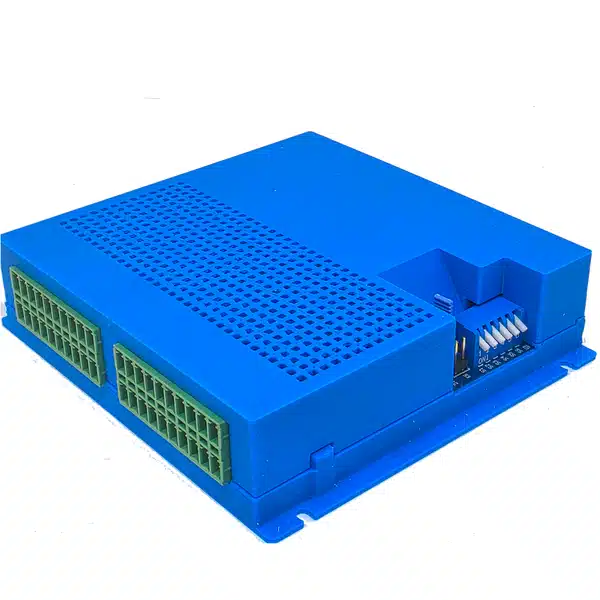
OC32/NG in housing
OC32NG AD module back
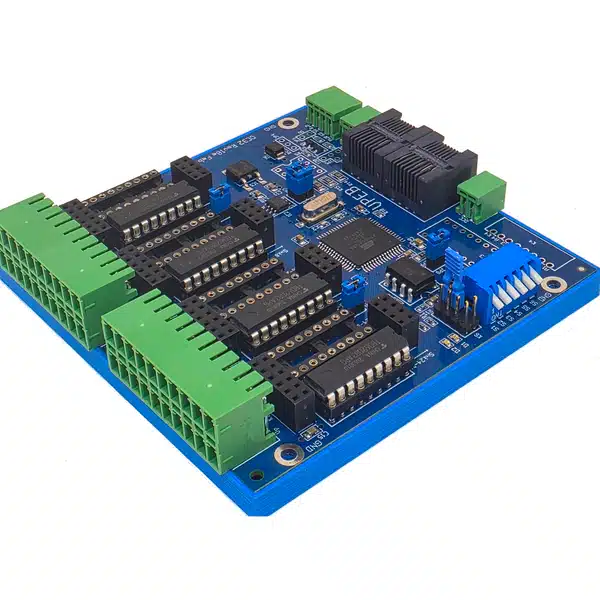
OC32/NG without housing
OC32
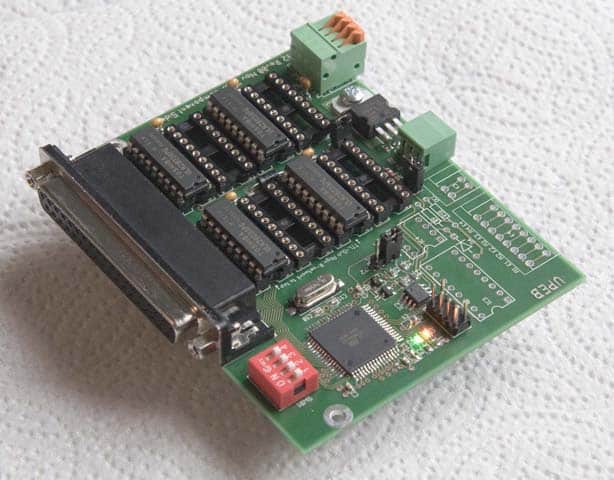
First generation OC32, still compatible with the OC32/NG and the latest generation firmware

Advantages of the OC32

Are there things the OC32 cannot do?

The OC32 does not (yet) control:

Are there any disadvantages to the OC32?

Actually, we can only think of one: Once you start using the OC32, you’ll keep coming up with new things in your miniature world that you can control with it. So there’s a risk you’ll constantly run out of outputs.

Why choose the OC32?

The major advantages of the OC32 accessory decoder:

One module for everything – light, motors, servos, and animation.
Space-saving – 32 outputs instead of multiple separate decoders.
Realistic behavior – fading, dimming, dynamic servo control, random effects.
Flexible and expandable – always updatable via software.
Robust and versatile – multiple protocols and compatible with existing systems.

👉 In short: the OC32 is the ultimate accessory decoder for anyone who wants more than simple switching.

Servo control

Servo control The OC32 features both simple servo control and dynamic control. Simple control includes:

The dynamic control of the OC32 is based on a physical model: the model of a mass on a spring with damping. By varying the parameters of this model, a wide variety of real-world situations can be simulated very realistically. Some examples:

The possibilities are virtually endless.

Turnout multiplexing: Effective and very economical

An interesting possibility offered by the OC32 is “turnout multiplexing”. This works for all standard twin-coil drives, for turnouts, but also for semaphore signals driven by them. Normally you use 2 outputs per turnout, one for straight and one for diverging. With multiplexing, you can control up to 32 turnouts (so 64 coils) with only 16 OC32 outputs—that’s only half an OC32!

To make wiring easy, MDdec connection boards are available. You simply connect your turnout drives to these as you are used to: with 3 wires each.

Relays

Some things you want to control require complete electrical isolation between the control and the device being controlled.
Examples include:

Despite all technical progress, the easiest and most economical solution is often simply… a relay.
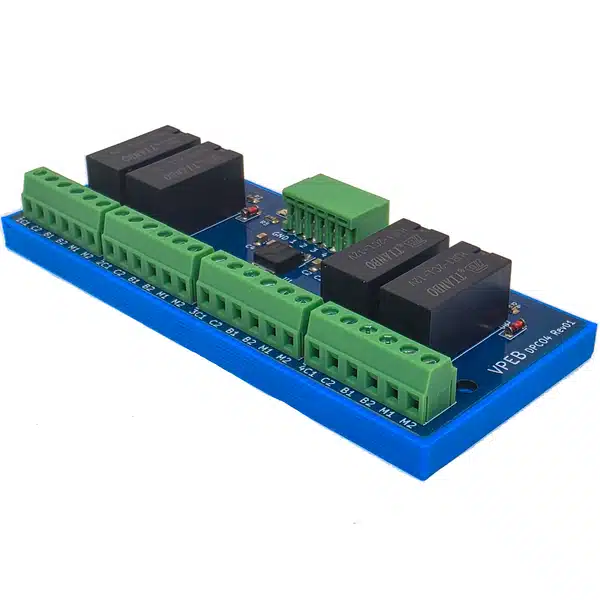
To make their application easy, VPEB has a number of compact relay modules in its range, which you can of course easily connect to an OC32 module. Not fancy, but very handy:

Discover all OC32 products

OC32/NG-AD Complete

OC32NG AD Complete front

Module with housing

OC32/NG-AD Module

OC32NG AD module

Module without housing, with mounting frame

DPCO4/12 Module

DPC04 back

Relay module

DPCO4/05 Module

DPC04 back

Relay module

U485J Complete

U485J

Connection module for OC32s to USB

DPCO4/12 Kit

VPEB

Relay module

DPCO4/05 Kit

VPEB

Relay module

OC32-ADM/CPX + CPX-CM

ADM CPX

For controlling Charlieplex signals

MDdec Rev02P

MDdecP

With plugs

SMF100 Stackable Mounting Frame – 5 pack

VPEB

OC32-ADM/PFH

PFH

For motors and 2-wire solenoid actuators

MDdec Rev02T

MDdecT

With screw terminals

SP04A mounting frame – 12 pack

VPEB

OC32-ADM/PSI

PSI

For 3-wire solenoid coils

OC32 Rev10 enclosure

OC32NG front

OC32-ADM/OCI

OCI

Galvanically isolated inputs

SP04A Rev00

sp04a

Connection module for 4 servos

CPX-CM Module

CPX CM

ADM/CPX connection board

OC32/NG Upgrade Kit -E

VPEB

OC32/NG Upgrade Kit -D

VPEB

SMF100 Stackable Mounting Frame

VPEB

TBD62783 (Source driver)

source driver

4116-1-R102 (1k Ohm)

resistorbank

4116-1-R221 (220 Ohm)

resistorbank

4116-1-R471 (470 Ohm)

resistorbank

4116-1-R331 (330 Ohm)

resistorbank

Opto-4

VPEB

TBD62083 (Sink driver)

sink driver