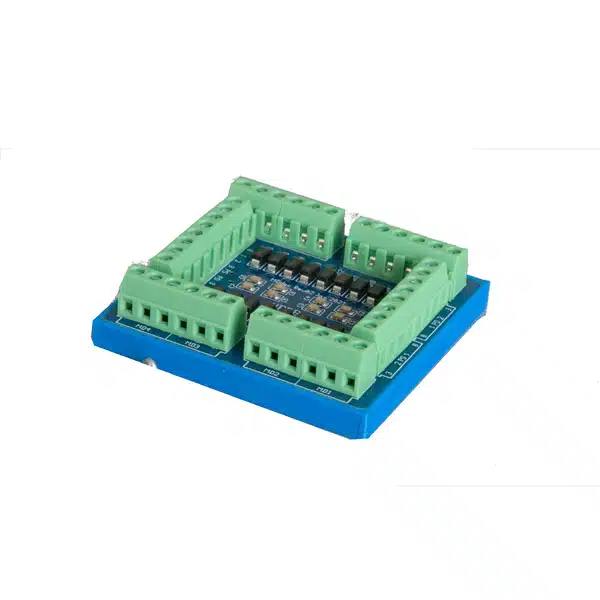
Description
The OC32 manual 3.0 describes how to connect turnout coils to the OC32. For each turnout, this costs you two OC32 outputs plus 2 transistors to amplify the current. If you use a DS32, it also costs you two connections on the DS32. All in all, it’s still a relatively affordable solution, but it can be even more efficient. This is especially interesting if you want to connect a larger number of turnouts. Turnout multiplexing saves on power electronics and wiring. To control 32 turnouts, you normally need 65 wires and 64 outputs: one wire and one output per coil, plus one common wire for all center taps of the twin-coil drives. With multiplexing, this is reduced to 16 wires and 16 outputs. And in the case of the OC32, you can use the saved outputs for other applications. The savings grow exponentially. Up to 4 turnouts, the savings are minimal or even negative. The more turnouts, the more you save. You can build the matrix yourself with wires, add the diodes yourself, and possibly add interference suppression components. However, you can also use the MDdec. This PCB is itself a 4 x 4 matrix, with the diodes and suppression capacitors already on it, providing the output for 8 turnouts. So it is effectively twice the circuit of figure 3. MDdecs can be cascaded for a larger matrix. With 2 MDdecs you create a 4 x 8 matrix, and with 4 MDdecs you create an 8 x 8 matrix.